

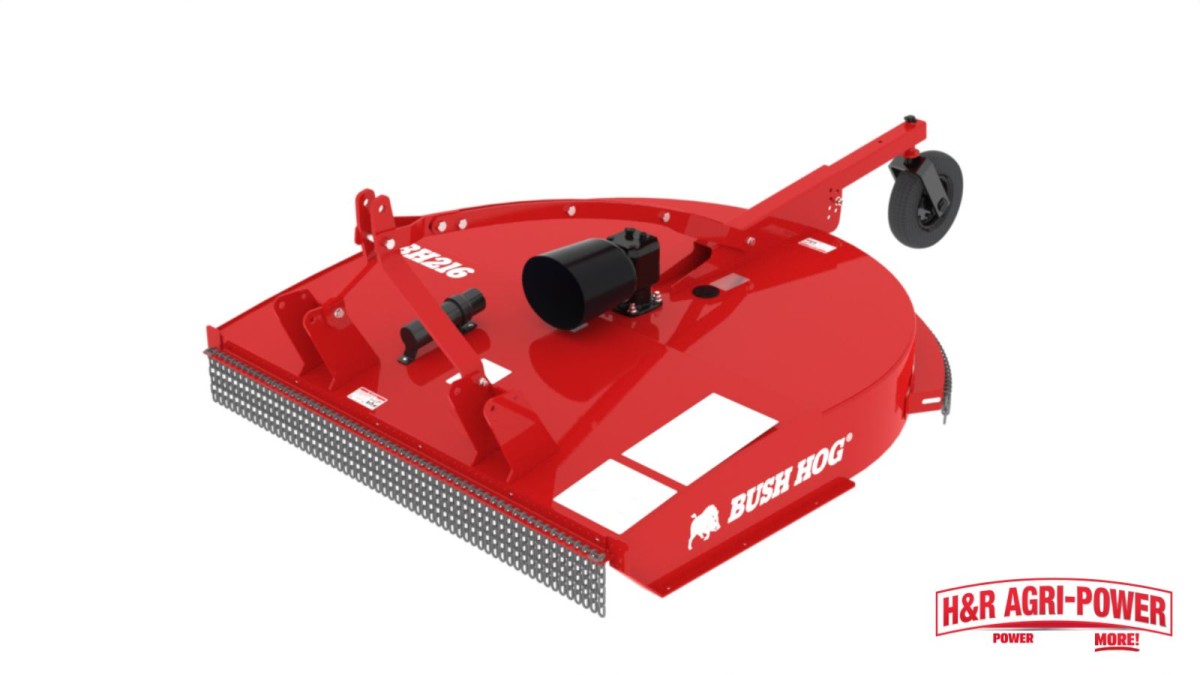
Pairing Bush Hog implements with compact and utility tractors is the process of matching a tractor's horsepower, PTO speed, hitch category, hydraulic capacity, and weight to the specific requirements of each Bush Hog attachment. A correct match protects both the tractor and the implement; an incorrect one risks mechanical failure, poor performance, and serious safety hazards.
This guide covers tractor-implement compatibility factors, Bush Hog implement types suited to smaller tractors, terrain and application assessment, common pairing mistakes, operational safety, and how H&R Agri-Power supports the selection process.
Compatibility starts with measurable specifications. PTO horsepower, three-point hitch category (0 through 4), hydraulic flow in gallons per minute, and tractor weight all determine which implements a machine can safely run. An oversized implement overloads the drivetrain, while an undersized one wastes capacity and invites unsafe ground speeds.
Bush Hog manufactures rotary cutters, finish mowers, compact tillers, box blades, post hole diggers, and front loaders specifically rated for compact and utility tractors in the 15 to 55 PTO HP range. Each model lists a minimum horsepower, hitch category, and PTO speed so operators can verify fit before purchase.
Terrain and intended use shape every pairing decision. Rough pasture, sloped ground, and heavy brush demand different implement features than flat-field landscaping or seedbed preparation. Matching the attachment to actual working conditions reduces rollover risk and extends equipment life.
Sizing errors, mismatched PTO speeds, and skipped maintenance are among the most common and costly pairing mistakes. Operating a 1,000 RPM implement on a 540 RPM tractor, for example, causes premature gearbox failure; neglecting front ballast with heavy rear-mounted attachments compromises steering control.
Safe operation depends on proper setup, ROPS with seatbelts, guarded PTO shafts, and consistent maintenance intervals. We at H&R Agri-Power, the 2024 Farm Equipment Dealer of the Year, carry the full Bush Hog lineup at 17 locations and provide hands-on pairing guidance at all 21.
What Factors Determine Compatibility Between Bush Hog Implements and Tractors?
Compatibility between Bush Hog implements and tractors depends on horsepower, PTO speed, tractor weight, hitch category, and hydraulic capacity. The following subsections break down each factor.
How Do Tractor Horsepower and PTO Requirements Influence Implement Selection?
Tractor horsepower and PTO requirements influence implement selection by setting the power boundaries for safe, efficient operation. According to Iowa State University Extension (Farm Machinery Selection, File A3-28), the horsepower needed to pull a given implement depends on implement width, ground speed, draft requirement, and soil condition.
Oversized implements cause tractor overloading, excessive tire slippage, and breakdowns. Undersized implements create inefficient operation and may encourage unsafe ground speeds. Drawbar horsepower losses average approximately 15%, and standard practice indicates that a power reserve of 17% of the original 100 percent be held in reserve.
Bush Hog specifies minimum PTO HP for each model. The BH114 rotary mower requires at least 15 HP, the BH1155 requires 20 HP, and the BH116 requires 25 HP, all at 540 RPM PTO speed. Operating below these thresholds risks engine damage; exceeding them can overpower the mower in heavy cutting. Matching PTO horsepower precisely to the implement's rated range is the single most important step in proper pairing.
What Role Does Tractor Size and Weight Play in Matching Implements?
Tractor size and weight play a critical role in matching implements because they determine stability, lift capacity, and safe weight distribution. According to Penn State Extension (Tractor Stability and Instability), a two-wheel drive tractor's center of gravity sits roughly 10 inches above and two feet in front of the rear axle, placing about 70% of the weight on the rear wheels.
A loaded implement must not exceed 1.5 times the tractor weight unless the implement weighs less than 3,300 lb. Target weight distribution with a mounted implement varies by drivetrain:
-
Two-wheel drive tractors require approximately 35% front and 65% rear weight distribution.
-
Front-wheel assist tractors require approximately 45% front and 55% rear.
-
Four-wheel drive tractors require approximately 60% front and 40% rear.
Adding front wheel weights and widening the rear tire setting enhances stability. A tractor can reach the rollover point of no return in just ¾ of a second, so proper ballasting before attaching any heavy Bush Hog implement is essential for operator safety.
How Important Are Hitch Types (Category 0, 1, 2) When Pairing Equipment?
Hitch types are critically important when pairing equipment because mismatched hitch categories cause pin shear, implement separation, and loss of control. The Association of Equipment Manufacturers and Canadian Agricultural Safety Association (Safe Implement Hitching Guide) defines five standard three-point hitch categories based on tractor PTO power:
|
Hitch Category |
PTO HP Range |
Lower Pin Diameter |
Lower Arm Spacing |
|
Category 0 |
Under 27 HP |
5/8 in. |
20 in. |
|
Category 1 |
Up to 64 HP |
7/8 in. |
26 in. |
|
Category 2 |
Up to 123 HP |
1 in. |
32 in. |
|
Category 3 |
107–248 HP |
1 1/4 in. |
38 in. |
|
Category 4 |
201–469 HP |
1 3/4 in. |
46 in. |
Most compact tractors under 40 HP use Category 1 hitches, while utility tractors typically require Category 1 or Category 2. Always verify that the Bush Hog implement's hitch rating matches the tractor's three-point hitch category before connecting.
What Should You Consider About Hydraulic and Electrical Connections?
You should consider hydraulic flow rate, system pressure, and electrical compatibility when pairing Bush Hog implements with any tractor. PTO-driven implements like rotary cutters rely on mechanical power, but hydraulic implements such as post hole diggers and loaders require specific gallons-per-minute (GPM) flow and pressure thresholds.
Bush Hog's PHDHF15-2 hydraulic post hole digger requires 6–15 GPM at up to 3,000 PSI, while the larger PHDHF35 demands 20–35 GPM at 3,500 PSI. Compact tractor hydraulic systems often produce only 9–11 GPM, which limits them to lighter-duty hydraulic attachments. Electrical connections for warning lights, implement monitors, or electronic controls must also match the tractor's wiring harness voltage and connector type. Verifying both hydraulic capacity and electrical compatibility before purchase prevents costly damage and performance failures.
With compatibility factors established, the next step is identifying which Bush Hog implements suit compact and utility tractors best.
Which Types of Bush Hog Implements Are Best Suited for Compact and Utility Tractors?
The types of Bush Hog implements best suited for compact and utility tractors span cutting, tillage, and material handling categories, all designed around Category 1 hitches and 540 RPM PTO systems.
What Cutting and Mowing Implements Work Well with Compact and Utility Tractors?
The cutting and mowing implements that work well with compact and utility tractors are Bush Hog rotary cutters and finish mowers sized for the under-40 HP range. The BH114 requires at least 15 HP, the BH115 at least 20 HP, and the BH116 at least 25 HP; all operate at 540 PTO RPM. Underpowering risks engine damage, while overpowering can destroy the mower in heavy conditions.
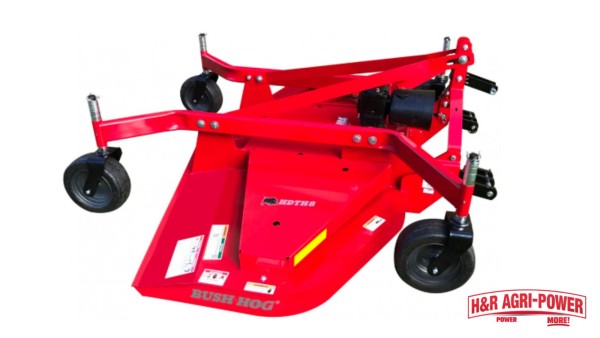
For finish mowing, the HDTH Series offers four widths. The HDTH5 (60 inches, 15 PTO HP) and HDTH6 (72 inches, 20 PTO HP) fit most compact tractors, while the HDTH7 and HDTH8 suit larger utility models. Each uses a Cat. 1 or Cat. 1/2 hitch with a 45 HP rated gearbox and 7-gauge steel deck.
According to the LSU AgCenter, rotary cutters can throw objects at speeds up to 200 mph, making pre-mowing debris inspection and properly maintained chain guards essential safety steps. Matching cut width to available horsepower remains the single most important decision for safe, effective mowing on compact equipment.
Which Tillage and Seedbed Implements Are Recommended for Smaller Tractors?
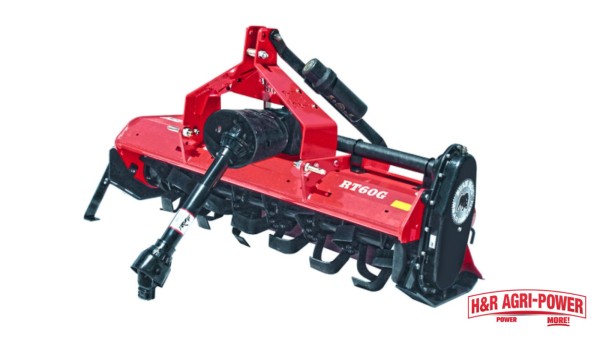
The tillage and seedbed implements recommended for smaller tractors include compact rotary tillers and box blades sized for Category 1 three-point hitches. Rotary tillers typically require 10 to 15 HP per foot of working width at full depth, so compact tractors should use narrow-width models to avoid overloading.
The Bush Hog RTC50G compact tiller fits tractors from 15 to 25 HP, delivers a 48-inch tilling width with a maximum depth of 6 inches, and weighs 374 lbs. It connects through a Category 1 hitch at 540 PTO RPM.
For grading and seedbed prep, the Bush Hog CBX48 and CBX60 compact box blades offer 48- and 60-inch working widths with a 12-inch box depth, ASAE Cat. I/QH hitches, and a maximum tractor rating of 24 PTO HP. Staying within these HP limits protects both the implement and the tractor drivetrain.
What Material Handling Attachments Pair Safely with Utility Tractors?
The material handling attachments that pair safely with utility tractors include Bush Hog's PTO-driven post hole diggers. Hydraulic flow and pressure compatibility are critical for these implements. The PHD2401 post hole digger fits Cat. 1 and 2 tractors, operates at 540 RPM with a 3.00:1 gear ratio, and accepts 6-, 9-, or 12-inch augers.
Hydraulic post hole digger models scale with tractor output: the PHDHF15-2 needs 6 to 15 GPM at 3,000 PSI maximum, while the PHDHF35 requires 20 to 35 GPM at 3,500 PSI. Always verify your tractor's hydraulic flow rate before selecting a loader or hydraulic attachment, since insufficient flow causes sluggish operation and premature pump wear.
Are There Specific Bush Hog Models Designed for Compact Tractor Use?
Yes, there are specific Bush Hog models designed for compact tractor use. The BH210-3 Series rotary cutters are purpose-built for this segment:
-
Model BH215-3: 5 ft. cut, 25 HP minimum
-
Model BH216-3: 6 ft. cut, 30 HP minimum
-
Model BH217-3: 7 ft. cut, 50 HP minimum
Blade bolts require torque to 450 ft.-lbs. before each use, and gearbox oil (SAE 80W-90 EP) should be changed when necessary. According to the LSU AgCenter, the ASAE defines compact utility tractors as machines under 4,000 lbs. with less than 40 PTO HP, designed for Category I implements only.
The RTC50G tiller, CBX compact box blades, and PHD2401 post hole digger also carry Category 1 hitch compatibility, making them natural pairings for this tractor class. Choosing from within Bush Hog's compact-rated lineup simplifies the matching process and helps protect your equipment investment.
How Should You Assess the Terrain and Application Before Selecting Bush Hog Attachments?
You should assess terrain and application by evaluating ground conditions, intended use, and slope hazards before selecting Bush Hog attachments. The following sections cover implement features for rough ground, how usage scenarios shape your choices, and safety concerns tied to specific terrain types.
What Implement Features Are Needed for Challenging or Rough Terrain?
The implement features needed for challenging or rough terrain include heavy-duty gearboxes, reinforced decks, stump jumpers, and chain guards designed to handle impacts and uneven ground. Rotary cutters with higher gearbox ratings, such as the Bush Hog BH200-3 series at up to 130 PTO HP gearbox capacity, absorb shock loads that rocky or stump-filled land produces. According to the LSU AgCenter, rotary cutters can throw objects at speeds of up to 200 mph, making intact chain guards and shields essential on debris-heavy ground. Wide-set rear tires and front wheel weights further enhance tractor stability on rough terrain, reducing the chance of an overturn. For operators working unimproved pastures or overgrown fence lines, prioritizing reinforced cutting decks and higher-rated driveline components prevents premature failure.
How Do Usage Scenarios (Farming, Landscaping, Maintenance) Affect Your Choices?
Usage scenarios affect your choices by determining the implement type, cutting width, and durability class you need. Farming applications like pasture management demand rotary cutters built for dense brush, while landscaping calls for finish mowers such as the Bush Hog HDTH series, which delivers a manicured cut at widths from 60 to 99 inches. Property maintenance often requires versatile implements. Box blades like the Bush Hog CBX48 and CBX60 handle grading and light gravel work on driveways, while compact tillers suit garden bed preparation. Matching the implement to the actual task prevents both underpowering and overspending. Operators who mow only maintained turf do not need a heavy rotary cutter, and those clearing rough pasture should not rely on a finish mower.
What Safety Concerns Arise When Using Implements on Specific Terrain Types?
The safety concerns that arise when using implements on specific terrain types include tractor overturns on slopes, thrown-object hazards on debris-covered ground, and PTO entanglement risks in confined areas. According to CDC/NIOSH data, tractor overturns are the leading cause of occupational fatalities in agriculture, accounting for approximately 130 deaths annually in the United States, with side overturns on slopes being the most frequent scenario. Before mowing any area, operators should inspect the ground and remove stones, wire, and cans that blades can launch at lethal speeds. PTO shafts must remain shielded at all times, and operators should never service or unclog an implement while the PTO is engaged. Steep or uneven terrain demands slower ground speeds, because doubling speed from 3 mph to 6 mph quadruples centrifugal force acting on the tractor.
Understanding terrain-specific risks ensures each Bush Hog attachment performs safely within its design limits.
What Are the Common Mistakes to Avoid When Matching Bush Hog Implements and Tractors?
The common mistakes to avoid when matching Bush Hog implements and tractors include incorrect sizing, PTO speed mismatches, and neglecting maintenance alignment. Each error carries distinct consequences for equipment life and operator safety.
How Can Incorrect Sizing of Implements Impact Tractor Performance or Longevity?
Incorrect sizing of implements impacts tractor performance or longevity by creating overload stress or inefficient underuse. According to Michigan State University Cooperative Extension Service (Extension Bulletin E-1152), implements too large for available horsepower cause tractor overloading, excessive tire slippage, and a higher incidence of breakdowns, while implements too small encourage unsafe ground speeds and increase per-acre operating costs.
Oversized rear-mounted implements also exceed rated lift capacity, causing hydraulic system damage and structural stress on the three-point hitch. Without front ballast to compensate, heavy rear implements shift the center of gravity and reduce front-axle steering control. Keeping a 17% power reserve above implement demand protects the drivetrain and ensures consistent field performance across varying conditions.
Why Is Overlooking PTO Compatibility a Costly Error?
Overlooking PTO compatibility is a costly error because running implements at the wrong shaft speed destroys gearbox components. Operating a 1,000 RPM implement on a 540 RPM tractor, for example, causes premature gearbox failure due to insufficient input speed and inadequate lubrication circulation.
According to FIMIC Implement, failing to use the correct hitch category compounds the problem by causing pin shear and complete implement separation during operation. Bush Hog rotary cutters and tillers for compact tractors are designed exclusively for 540 RPM PTO output. Connecting any implement without first confirming both RPM rating and hitch category match invites mechanical failure that often costs more to repair than the implement itself.
What Maintenance Challenges Occur When Implements and Tractors Are Not Properly Paired?
Maintenance challenges that occur when implements and tractors are not properly paired include accelerated wear on hydraulic systems, shortened gearbox service intervals, and chronic fastener failures. An undersized tractor running a too-heavy implement operates continuously near peak load, which degrades hydraulic seals and overheats transmission fluid faster than standard maintenance schedules anticipate.
Mismatched pairings also make routine tasks harder to perform correctly. Blade bolt torque checks, PTO driveline greasing, and gearbox oil changes become more frequent when components absorb stresses beyond design specifications. These compounding maintenance demands increase total ownership costs and create safety risks from deferred repairs.
Recognizing these pairing mistakes early helps operators protect both equipment and personal safety during field operations.
How Can You Ensure Safety and Operator Comfort When Using Paired Equipment?
You can ensure safety and operator comfort when using paired equipment by following proper set-up procedures, using modern tractor safety features, and maintaining both the tractor and implement on a consistent schedule.
What Precautions Should Be Taken During Set-Up and Operation?
The precautions that should be taken during set-up and operation include clearing the work area, verifying all guards are in place, and following safe operating procedures before engaging any implement. Rotary cutters can throw objects at speeds of up to 200 mph, according to the LSU AgCenter, making pre-mowing debris removal critical.
Key precautions to follow before and during operation:
-
Inspect the entire mowing or work area and remove rocks, wire, tin cans, and other debris that blades could launch.
-
Confirm that chain guards and shields are in good condition and securely attached to reduce thrown-object risk.
-
Verify that all PTO shields and power transmission guards are in place; replace them immediately after any maintenance.
-
Never allow extra riders on the tractor, and keep bystanders well outside the working area.
-
Stop the engine, disconnect the power source, and wait for the PTO shaft to stop completely before servicing, adjusting, or unclogging equipment.
Federal child labor law also restricts who may operate this equipment: anyone under 16 cannot operate a tractor over 20 PTO HP unless working for a parent or guardian on their farm, though 14-year-olds with special training may qualify.
How Do Modern Tractor Features Contribute to Safe Implement Use?
Modern tractor features contribute to safe implement use by providing structural rollover protection, PTO guarding systems, and operator comfort designs that reduce fatigue-related errors. According to OSHA Publication OSHA3835, agricultural tractors manufactured after October 25, 1976 with over 20 horsepower are required to have rollover protective structures (29 CFR 1928.51(b)(1)), and all PTO shafts must be guarded by a master shield or equivalent protective guarding (29 CFR 1928.57(b)(1)(i)).
ROPS paired with a seat belt reduces the risk of death in a tractor overturn by approximately 99%. Given that tractor overturns account for roughly 44% of all U.S. farm fatalities, this single feature represents the most effective safety investment on any tractor. Adding front wheel weights and setting rear tires to a wide stance further improves stability when running heavy rear-mounted implements like rotary cutters or tillers.
Why Is Routine Maintenance Important for Paired Tractor-Implement Performance?
Routine maintenance is important for paired tractor-implement performance because worn or neglected components compromise both cutting quality and operator safety. Dull rotary cutter blades increase thrown-object risk and strain the PTO drivetrain. Sharp, balanced blades reduce vibration and deliver cleaner cuts.
Essential maintenance tasks for paired equipment include:
-
Tightening blade bolts to the manufacturer's specified torque before each use.
-
Replacing both blades on a spindle simultaneously with blades of equal weight to prevent imbalance.
-
Greasing the PTO driveline's outer (female) section with multipurpose grease before each use.
-
Changing gearbox oil when necessary.
-
Inspecting chain guards, shields, and PTO covers after every maintenance session and replacing any damaged components immediately.
Skipping these steps accelerates wear on both the implement gearbox and the tractor's hydraulic system, turning a minor oversight into a costly repair. With safety and maintenance fundamentals established, the right dealer partnership makes proper pairing straightforward from the start.
How Can H&R Agri-Power Help You Pair Bush Hog Implements with Your Tractor?
H&R Agri-Power can help you pair Bush Hog implements with your tractor through expert equipment matching, genuine parts supply, and dedicated maintenance services across 17 locations in six states. The sections below cover available services and key takeaways from this guide.
What Equipment Sales, Parts, and Maintenance Services Does H&R Agri-Power Offer for Tractor-Implement Pairing?
H&R Agri-Power offers equipment sales, parts, and maintenance services specifically designed for tractor-implement pairing. As the 2024 Farm Equipment Dealer of the Year in the over $100 million revenue category, H&R Agri-Power carries Bush Hog as one of its shortline brands alongside Land Pride, Kuhn, Vermeer, and dozens more. With 599 employees across stores in Kentucky, Tennessee, Illinois, Alabama, Indiana, and Mississippi, the dealership covers over 90 million acres of farming territory.
"Whoever can give you the best service is going to win the day. We brought that mindset into this business. It's also unique that we are farmers, which gives us insight into what farmers want and need," said Steve Hunt, President and COO of H&R Agri-Power. That farmer-first perspective means H&R Agri-Power staff can walk you through PTO horsepower requirements, hitch category compatibility, and proper ballasting for any Bush Hog rotary cutter, tiller, or box blade in the lineup.
What Are the Key Takeaways About How to Pair Bush Hog Implements with Compact and Utility Tractors We Covered?
The key takeaways about how to pair Bush Hog implements with compact and utility tractors are:
-
Match your tractor's PTO horsepower to the implement's minimum requirement, and maintain a 17% power reserve to prevent engine overloading.
-
Verify hitch category compatibility before purchase; a Category 1 implement will not safely connect to a Category 2 or 3 hitch without proper adapters.
-
Confirm that implement weight does not exceed 1.5 times your tractor's weight, and add front ballast when running heavy rear-mounted attachments.
-
Check hydraulic flow (GPM) and pressure (PSI) ratings for any loader or hydraulic-driven attachment.
-
Always ensure ROPS with seatbelts are installed; according to the Great Plains Center for Agricultural Health at the University of Iowa, ROPS with seatbelts reduce the risk of death in a tractor overturn by approximately 99%.
-
Maintain chain guards, PTO shields, and sharp blades on rotary cutters to reduce thrown-object hazards.
Getting the right match between your tractor and Bush Hog implement protects your equipment investment, your productivity, and your safety. H&R Agri-Power is ready to help you find that match at any of its 17 Bush Hog locations.