

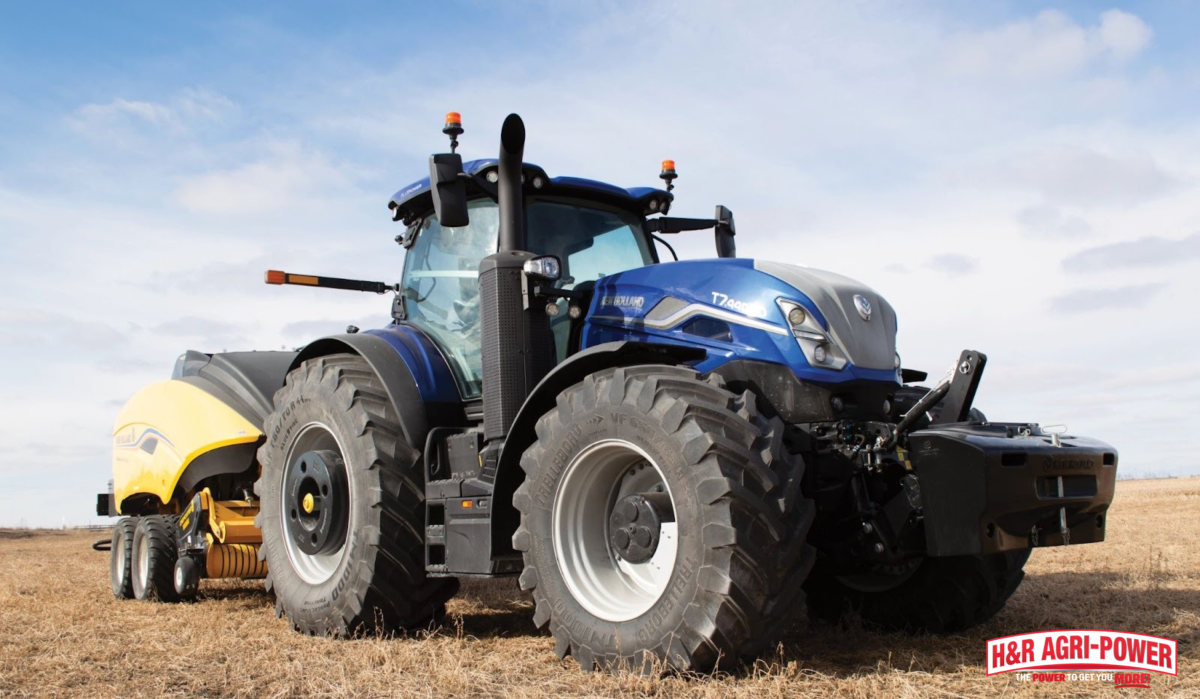
Maximizing New Holland equipment for multi-farm operations means coordinating fleet utilization, maintenance, precision technology, and scaling strategies so every machine delivers peak productivity across every location.
This guide covers equipment suitability for large-scale use, scheduling and utilization optimization, maintenance strategies, precision farming integration, and fleet scaling considerations.
New Holland's T7 series tractors, ranging from 155 to 435 hp across multiple configurations, provide the power and built-in PLM intelligence that multi-farm operations demand. Best-in-class fuel efficiency and FieldOps connectivity make these machines a strong foundation for distributed farming enterprises.
Strategic equipment rotation and telematics-based fleet tracking keep the right machines at the right sites during critical windows. We explore how GPS monitoring, coordinated transport planning, and usage data reduce idle time and eliminate costly overlap between locations.
Proactive maintenance protects your investment as equipment moves between farms and accumulates hours faster than single-site machines. We cover service intervals, preventative protocols, and the role of 24/7 mobile service support in keeping repair costs controlled.
Precision agriculture tools integrated with New Holland's PLM platform enable data-driven input management, variable rate application, and cross-farm data sharing. These technologies can boost productivity, cut fertilizer and fuel use, and create a unified operational picture across all sites.
Scaling a New Holland fleet requires careful assessment of equipment needs, financial analysis of buying versus leasing, and dealership support from partners like H&R Agri-Power. We break down the factors that determine when and how to expand your equipment lineup profitably.
What Makes New Holland Equipment Suited for Multi-Farm Operations?
New Holland equipment suits multi-farm operations through high-horsepower versatility, best-in-class fuel efficiency, and integrated precision technology. The sections below cover key features of the T7 tractor lineup and how these capabilities translate to efficiency gains across multiple farm sites.
Which Key Features of New Holland Tractors and Implements Support Large-Scale Use?
The key features of New Holland tractors and implements that support large-scale use include a powerful engine platform, industry-leading fuel economy, and built-in precision technology. According to New Holland Agriculture, the T7 Heavy-Duty models use the FPT Cursor 9, an 8.7-liter, 6-cylinder engine.
The T7 series spans four configurations to match different operational demands:
|
T7 Series Model |
Horsepower Range |
Primary Application |
|
Standard Wheelbase |
155–185 hp |
Versatile general-purpose tasks |
|
Long Wheelbase |
180–260 hp |
Increased stability and pulling power |
|
Heavy-Duty |
270–340 hp |
Demanding high-horsepower field work |
|
Xtra Duty (XD) |
360–435 hp |
Maximum power with advanced PLM integration |
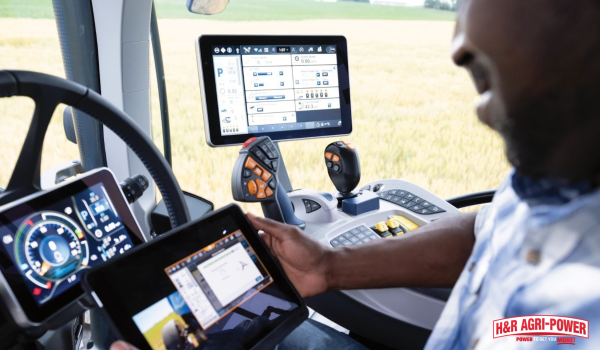
Precision Land Management (PLM) intelligence, including the IntelliView 12 monitor and FieldOps connectivity, gives operators centralized data management, guidance, and automation across every site. For multi-farm managers juggling several locations, this range of configurations paired with a unified technology platform means one equipment line can handle nearly every task without sacrificing specialization.
How Does New Holland Equipment Enhance Efficiency Across Multiple Farms?
New Holland equipment enhances efficiency across multiple farms by enabling the economies of scale that larger, consolidated operations depend on. A 2018 USDA Economic Research Service study found that cost per unit of output for large farms (over 1,000 acres) was $1.61, compared to $2.96 for small farms, a difference exceeding 50%.
This cost advantage stems from spreading labor and capital expenses across greater acreage. New Holland's T7 platform supports that model directly: standardized controls and PLM connectivity across all configurations reduce training time when operators move between sites, while consistent service intervals simplify fleet-wide maintenance planning. The result is lower per-acre operating costs as a multi-farm operation scales.
In practice, the combination of uniform technology and scalable horsepower options is what separates a well-run multi-farm fleet from a collection of mismatched machines. With the right scheduling and precision tools in place, these efficiency gains compound across every additional acre under management.
How Can You Optimize Equipment Utilization and Scheduling Across Different Farms?
You can optimize equipment utilization and scheduling across different farms by implementing strategic rotation plans and real-time usage tracking. The following subsections cover best practices for moving machinery between locations and monitoring performance to reduce costly downtime.
What Are the Best Practices for Equipment Rotation and Transport Between Locations?
The best practices for equipment rotation and transport between locations center on strategic deployment planning and real-time fleet visibility. In a multi-farm setting, ensuring the right machinery reaches the right field at the right time minimizes idle hours and maximizes productivity across every location.
Key practices include:
-
Mapping seasonal task calendars for each farm so equipment moves align with planting, spraying, and harvest windows.
-
Assigning primary and secondary locations to each machine based on acreage, soil type, and workload intensity.
-
Using GPS tracking and telematics systems to monitor real-time location, operational status, and performance metrics for every unit in the fleet.
New Holland's FieldOps platform, supported by precision ag partners like Razor Tracking, provides the connectivity needed to make informed allocation decisions. Rather than relying on guesswork or phone calls, farm managers can view their entire fleet on a single dashboard and reroute equipment as field conditions change. For operations spanning multiple counties or states, this level of visibility is not optional; it is the difference between a well-coordinated season and a logistical breakdown.
How Can You Track Equipment Usage to Reduce Downtime and Overlap?
You can track equipment usage to reduce downtime and overlap by combining telematics data with structured scheduling protocols. Telematics systems log engine hours, fuel consumption, and task completion for each machine, making it simple to identify units sitting idle or duplicating work across locations.
According to a 2025 Morning Ag Clips report, unplanned equipment failures can cost farmers an average of $3,348 per season in downtime losses. Tracking usage data helps prevent this by flagging machines approaching service thresholds before breakdowns occur. Overlapping deployments, where two tractors perform similar tasks on adjacent fields, become immediately visible when usage logs are reviewed weekly.
Setting utilization benchmarks for each machine and comparing actual hours against targets reveals underused assets that could be redeployed or removed from the fleet entirely. This disciplined, data-driven approach turns raw telematics information into actionable scheduling decisions that protect both uptime and operating margins.
With utilization and scheduling optimized, consistent maintenance becomes the next priority for protecting equipment longevity.
What Maintenance Strategies Help Extend the Life of New Holland Equipment in Multi-Farm Environments?
Maintenance strategies that help extend the life of New Holland equipment in multi-farm environments include consistent service intervals, preventative inspections, and access to responsive dealership support. The following subsections cover service frequency and cost-reducing preventative measures.
How Often Should You Service or Inspect New Holland Equipment for Multi-Farm Use?
You should service or inspect New Holland equipment for multi-farm use at every manufacturer-recommended interval, with additional checks before and after transporting machines between locations. Equipment operating across multiple sites accumulates hours and wear faster than single-farm machinery, making strict adherence to service schedules essential.
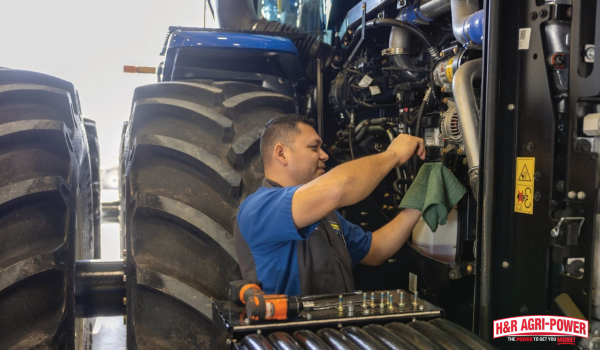
Access to responsive service support matters just as much as the schedule itself. H&R Agri-Power maintains a large parts inventory, 24/7 mobile service, and a team of manufacturer-trained technicians designed to minimize downtime and maximize equipment productivity. For multi-farm operators juggling logistics across several locations, this kind of after-the-sale commitment prevents minor issues from becoming major breakdowns. Scheduling pre-season and mid-season inspections, rather than waiting for failures, is one of the most reliable ways to protect equipment value over time.
What Preventative Maintenance Measures Reduce Long-Term Repair Costs?
Preventative maintenance measures that reduce long-term repair costs include routine fluid changes, filter replacements, belt inspections, and following manufacturer-specified service programs. A structured maintenance plan is especially critical given that equipment and repair costs have increased by 41% since 2020, according to a 2023 Ag Equipment Intelligence report, which also found that improved routine maintenance can lower repair costs by as much as 25%.
Key preventative maintenance practices for multi-farm operations include:
-
Performing oil, coolant, and hydraulic fluid changes at recommended hour intervals.
-
Inspecting and replacing filters, belts, and hoses before visible wear causes failure.
-
Greasing all pivot points and moving components on a consistent schedule.
-
Keeping machinery expenses below 25% of annual gross revenue, as agricultural economists recommend.
Unplanned downtime costs farmers an average of $3,348 per season, making reactive repairs far more expensive than scheduled upkeep. For operations running New Holland equipment across multiple sites, the compounding effect of deferred maintenance is even greater, since one breakdown can disrupt schedules across every farm in the rotation. Investing in a documented preventative maintenance program is one of the most cost-effective decisions a multi-farm operator can make.
With maintenance protocols established, integrating precision farming technology further enhances equipment performance across sites.
How Does Precision Farming Technology Integrate With New Holland Equipment for Multi-Farm Operations?
Precision farming technology integrates with New Holland equipment through the PLM Intelligence platform, which connects GPS guidance, autosteer, and variable rate controls across every machine in a fleet. The sections below cover compatible tech solutions and data-sharing strategies for multi-site productivity.
What Precision Tech Solutions Are Compatible With New Holland Systems?
The precision tech solutions compatible with New Holland systems include GPS guidance, autosteer, yield monitoring, and variable rate application control, all unified under the PLM Intelligence platform. New Holland's FieldOps platform extends this capability by providing real-time data monitoring and fleet management across multiple locations.
H&R Agri-Power's Precision Ag department supports these technologies with specialists who handle system implementation, data management, and ongoing operational support. Compatible solutions span leading brands, including Case IH, Ag Leader, Trimble, and Raven, ensuring interoperability across mixed equipment fleets.
According to a 2023 report by the Association of Equipment Manufacturers, precision agriculture can increase productivity by 5%, reduce fertilizer use by 8%, and decrease fuel consumption by 7%. For operators managing dispersed acreage, this interoperability is what makes a unified precision strategy realistic rather than theoretical.
How Can Data Sharing Improve Productivity Across Multiple Farm Sites?
Data sharing improves productivity across multiple farm sites by centralizing yield maps, soil data, and machine performance metrics into a single platform accessible from any location. When field-level information flows between sites, managers can compare input efficiency, identify underperforming zones, and reallocate resources without physically visiting each property.
New Holland's FieldOps connectivity enables this centralized approach by syncing data from every equipped machine in real time. Operators at one farm can review conditions at another, reducing redundant scouting trips and speeding up decision cycles.
For multi-farm operations, the practical advantage is clear: consistent data across sites eliminates guesswork during planting and application windows. Prioritizing a connected data ecosystem across your New Holland fleet is one of the most cost-effective ways to scale precision benefits without scaling labor.
What Factors Should You Consider When Scaling Up Your New Holland Fleet?
The factors you should consider when scaling up your New Holland fleet include current workload demands, future acreage projections, and the financial trade-offs between buying and leasing. The following sections cover needs assessment and cost-benefit analysis.
How Do You Assess Equipment Needs as Your Operation Expands?
You assess equipment needs as your operation expands by evaluating current machine utilization rates, identifying workflow bottlenecks, and projecting future acreage or enterprise growth. Start by auditing hours logged on each unit across all farm sites. Equipment consistently running at or near maximum seasonal capacity signals the need for additional units or higher-horsepower models.
Matching the right machine class to each task matters more than simply adding units. Consider factors such as:
-
Total acreage each machine must cover per season
-
Peak-season overlap between farm locations
-
Soil types and terrain that may require specialized configurations
-
Compatibility with existing precision agriculture systems
Agricultural economists recommend keeping total machinery expenses below 25% of annual gross revenue. Using that benchmark during your assessment prevents over-capitalization while ensuring adequate capacity. For multi-farm operators, the goal is eliminating idle time at one location while another site waits for the same machine.
What Is the Cost-Benefit Analysis of Buying Versus Leasing Additional Equipment?
The cost-benefit analysis of buying versus leasing additional equipment centers on cash flow flexibility, tax implications, and long-term ownership value. Purchasing builds equity and suits operations planning to keep machines for their full useful life. Leasing, by contrast, lowers upfront capital requirements and simplifies fleet turnover cycles.
A present value analysis by Penn State Extension found that leasing could yield savings of $1,141 over purchasing, assuming a 6% interest rate and 14% after-tax rate. Key evaluation factors include:
-
Depreciation schedules and residual value projections
-
Interest rates on purchase financing versus lease payments
-
Expected annual utilization hours across all farm sites
-
Tax treatment differences between lease payments and ownership deductions
For rapidly expanding multi-farm operations, leasing often provides the agility to scale equipment capacity without tying up working capital. Operators with stable, long-term acreage commitments typically benefit more from ownership. With fleet financing decisions carrying this much weight, working through the numbers with a knowledgeable dealer ensures the chosen path aligns with both current cash flow and future growth plans.
How Can H&R Agri-Power's Services Help You Maximize New Holland Equipment Across Multiple Farms?
H&R Agri-Power's services help you maximize New Holland equipment across multiple farms through inspections, parts availability, precision technology support, and 24/7 mobile service across 6 locations. The following sections detail these capabilities and summarize key takeaways.
How Do H&R Agri-Power's Inspections, Parts, and Precision Technology Solutions Support Multi-Farm Operations?
H&R Agri-Power's inspections, parts, and precision technology solutions support multi-farm operations by combining proactive equipment care with advanced ag tech expertise across a four-state New Holland dealership network. H&R Agri-Power staffs over manufacturer-trained technicians and deploys mobile service trucks for on-farm diagnostics, reducing the logistical burden of maintaining equipment spread across distant locations.
The Precision Ag department addresses a critical adoption gap. According to a 2024 U.S. Government Accountability Office report, high upfront costs and limited technical expertise remain the primary barriers preventing smaller operations from adopting guidance and autosteer systems. H&R Agri-Power bridges this gap by offering implementation support and solutions from brands such as Ag Leader, Trimble, and Raven alongside New Holland's PLM platform. For operations managing multiple sites, this single-dealer approach to parts, service, and technology simplifies what would otherwise require coordination across several vendors.
What Are the Key Takeaways About How to Maximize New Holland Equipment for Multi-Farm Operations We Covered?
The key takeaways about how to maximize New Holland equipment for multi-farm operations are:
-
New Holland's T7 series tractors provide scalable horsepower and integrated PLM intelligence suited to diverse field conditions across multiple sites.
-
Strategic equipment rotation, GPS tracking, and telematics reduce idle time and prevent scheduling overlaps between farm locations.
-
Preventative maintenance programs lower repair costs significantly, while rising industry repair expenses make proactive service essential.
-
Precision farming technology delivers measurable gains in productivity, fuel savings, and input reduction when properly implemented.
-
Leasing versus purchasing decisions should be evaluated through cost-benefit analysis tailored to each operation's cash flow needs.
-
A dealership partner with broad geographic coverage, dedicated precision ag specialists, and 24/7 service capabilities ties all these strategies together.
H&R Agri-Power combines more than 50 years of experience with 6 New Holland locations to deliver the selection, service, and solutions that multi-farm operations depend on.