

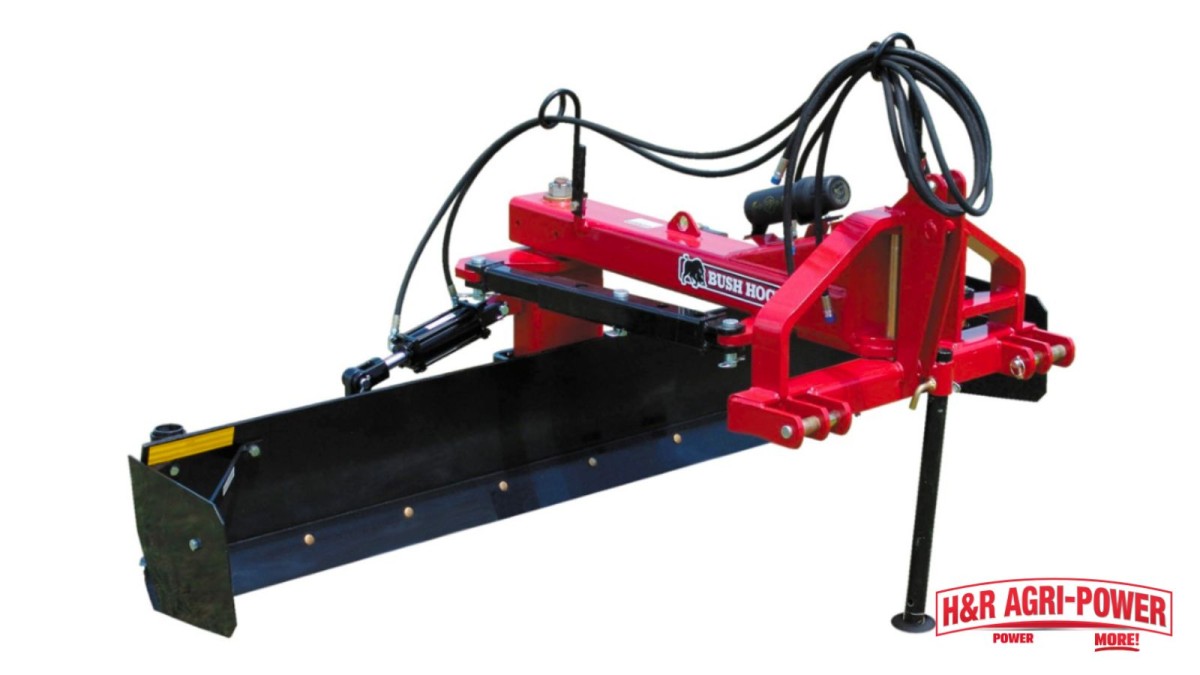
Bush Hog rear blades are tractor-mounted grading implements designed to level, crown, and redistribute gravel on driveways, farm lanes, and rural roads. With models spanning compact 4-foot blades for small properties to heavy-duty 14-foot blades for county road crews, they remain one of the most versatile tools for property surface maintenance.
This guide covers gravel driveway grading fundamentals, blade selection criteria for different property types, how rear blades compare to other implements, the most popular Bush Hog models, long-term blade care, and where to find expert support.
Gravel surfaces rut in wet weather and lose material to shoulders in dry conditions, so proper maintenance requires a blade that can reshape the crown, clear drainage ditches, and redistribute loose aggregate in a single pass. Bush Hog rear blades handle all three tasks through adjustable tilt, offset, and angle settings.
Choosing the right blade depends on tractor horsepower, property size, and soil conditions. Compact series blades suit residential driveways and landscaped paths on tractors from 15 PTO HP, while the 160 Series handles heavy grading on tractors up to 190 HP with its reinforced moldboard and reversible cutting edge.
Rear blades excel at precision grading work where box blades and land planes can be too aggressive or too passive. Understanding when each implement fits best prevents overspending and underperforming on routine property upkeep.
Routine inspections of cutting edges, king pins, and hydraulic connections keep a rear blade performing at full capacity season after season. Proper maintenance also protects your investment against accelerated wear from sandy or rocky soil conditions.
We at H&R Agri-Power help property owners and professionals match the right Bush Hog rear blade to their operation, backed by parts inventory, service expertise, and warranty support.
How Do Bush Hog Rear Blades Improve Gravel Driveway Maintenance?
Bush Hog rear blades improve gravel driveway maintenance by reshaping displaced material, restoring proper crown, and promoting drainage. The subsections below cover essential blade features and how rear blades level gravel surfaces.
What Features Should You Look for in a Rear Blade for Gravel?
The features you should look for in a rear blade for gravel include proper sizing, hydraulic adjustability, and controls that support drainage. Gravel surfaces rut easily in wet weather, and traffic displaces material to the shoulders during dry conditions, so a blade must address both problems.
Key features to prioritize:
-
Blade width slightly wider than the tractor's rear tires, ensuring full coverage across the driving surface in each pass.
-
Hydraulic tilt for ditching and shoulder work.
-
Pitch angle adjustment for increasing cutting aggressiveness or reducing drag.
-
Side shift capability for working close to fences or obstacles.
-
Crown control so water sheds off instead of pooling and creating potholes.
According to an EPA gravel road maintenance guide, proper upkeep requires three basic items: a properly shaped road surface, a shoulder area that slopes away from the driving surface, and a ditch. A rear blade with these adjustment features addresses all three requirements in a single implement.
How Do Rear Blades Help Maintain and Level Gravel Surfaces?
Rear blades help maintain and level gravel surfaces by redistributing loose material back to the center of the driving path and restoring the crowned profile that prevents water damage. A properly angled rear blade pulls displaced gravel from shoulders and fills ruts, creating a smooth, evenly graded surface.
According to RoadRunner Equipment, choosing the right grader blade for your tractor is key to ensuring gravel road maintenance, farm lane leveling, and job site prep are done efficiently and correctly. The moldboard acts as a precision grading tool when tilted and pitched appropriately, allowing operators to rebuild surface shape in fewer passes. For most property owners, regular light grading prevents the deep ruts and potholes that require costly re-graveling.
Understanding these maintenance fundamentals helps narrow down which blade size and configuration best fits your property type.
What Are the Key Factors to Consider When Choosing a Rear Blade for Property Upkeep?
The key factors to consider when choosing a rear blade for property upkeep include blade size, material durability, adjustment options, and safe operating practices. The following sections break down sizing, angle settings, and essential safety tips.
Which Blade Size and Material Are Best for Different Property Types?
The best blade size and material depend on property scale and tractor horsepower. For small farms and rural homesteads with 35 to 90 HP tractors, a 6- to 7-foot blade handles driveways and lanes efficiently. Larger agricultural operations running 90+ HP tractors benefit from 8- to 10-foot heavy-duty blades with reinforced moldboards and thick cutting edges.
Material composition matters just as much as width. Look for high-strength steel moldboards, powder-coated finishes for corrosion resistance, and reversible cutting edges that double usable life before replacement. Matching blade width slightly wider than your tractor's rear tires ensures full-pass coverage and fewer overlapping runs.
How Important Are Adjustment Options and Blade Angle Settings?
Adjustment options and blade angle settings are critical for achieving precise grading results across different tasks. Bush Hog 160 Series Rear Blades offer tilt adjustment of 15 degrees up or down, offset adjustment of 37 inches left or right, and angle adjustment of 45 degrees left or right in both forward and reverse positions, all available in manual or hydraulic configurations.
For residential and landscaping projects, a compact blade in the 6- to 7-foot range with manual tilt and pitch settings is usually sufficient for occasional regrading or driveway work. Hydraulic controls become worthwhile on properties requiring frequent adjustments, since operators can change settings from the cab without dismounting. Investing in full adjustment capability upfront prevents costly limitations later.
What Safety and Usage Tips Should Owners Know?
The safety and usage tips owners should know center on proper equipment shutdown, personal clearance, and routine pre-operation checks. According to OSHA standard 1928.57, the engine must be stopped, the power source disconnected, and all machine movement ceased before performing any servicing or maintenance on farm field equipment.
Before each use, owners should follow these practices:
-
Walk around the blade to inspect for loose bolts, cracked welds, or worn cutting edges.
-
Verify that all guards and shields are securely fastened and free from burrs or sharp edges.
-
Confirm hydraulic lines show no leaks or damage before engaging adjustments.
-
Keep bystanders well clear of the work area during operation.
With proper blade selection and safe operating habits in place, understanding how Bush Hog models compare to other tools helps narrow the best choice.
How Do Bush Hog Rear Blades Compare to Other Gravel Driveway Tools?
Bush Hog rear blades compare favorably to other gravel driveway tools by offering superior versatility and adjustability for grading, leveling, and shaping surfaces. The sections below cover the pros and cons against box blades and land planes, plus when a rear blade is the best implement choice.
What Are the Pros and Cons of Rear Blades vs. Box Blades or Land Planes?
The pros of rear blades include multi-directional adjustability, wide model range, and versatility across tasks; the cons include less material-carrying capacity than box blades and less finish-leveling precision than land planes. Box blades trap and redistribute loose material effectively in contained areas, while land planes excel at producing smooth, flat surfaces over long stretches. Rear blades, however, handle the broadest range of jobs. According to Bush Hog, the 160 Series Rear Blades are ideal for heavy-duty grading chores such as road construction, terracing, dam building, feedlot cleaning, and snow removal. Bush Hog rear blade series span from Compact models (4 to 6 ft., 136 to 164 lbs.) through the 300 Series (12 to 14 ft., 3,463 to 3,603 lbs.), covering tractors from 15 PTO HP to over 300 PTO HP. That range makes rear blades the most adaptable single-implement investment for property owners who need one tool across multiple tasks.
When Should You Use a Rear Blade Instead of Other Implements?
You should use a rear blade instead of other implements when the job requires angled grading, shoulder shaping, ditch maintenance, or crown building on gravel surfaces. Rear blades suited for 35 to 90 HP tractors serve small farms, rural properties, and landscaping contractors, while models built for 90+ HP tractors handle county road maintenance and large agricultural operations. Because a rear blade tilts, offsets, and angles independently, it manages tasks that box blades and land planes cannot perform without additional attachments. For property owners juggling driveway grading, drainage work, and seasonal snow clearing, a single rear blade eliminates the need for multiple implements. With the right model selected, identifying the most popular Bush Hog rear blade series helps narrow the decision further.
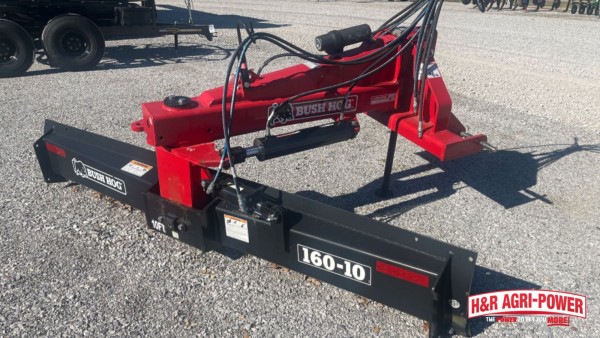
What Are the Most Popular Bush Hog Rear Blade Models for Gravel Driveways?
The most popular Bush Hog rear blade models for gravel driveways span from compact series for homeowners to heavy-duty options for professional grading. Crown control and drainage performance separate the best choices.
How Do Case IH, Land Pride, and New Holland Rear Blades Differ?
Case IH, Land Pride, and New Holland rear blades differ primarily in tractor compatibility, hitch categories, and the dealer support network behind each brand. Case IH implements pair with higher-horsepower utility and row-crop tractors, making them well suited for larger properties and farm road systems. Land Pride rear blades are designed for compact and sub-compact tractors, fitting homeowners who maintain shorter driveways or landscaped paths. New Holland rear blades bridge both segments, covering mid-range utility tractors common on mixed-use properties.
All three brands use Category 1 and Category 2 three-point hitch systems. The real differentiator is often local parts availability and service expertise, which directly affects long-term ownership cost.
Which Rear Blades Are Recommended for Homeowners Versus Professional Use?
The rear blades recommended for homeowners versus professional use depend on tractor horsepower, driveway length, and grading frequency. According to RoadRunner Equipment, C-Series grader blades designed for 40 to 90 HP tractors are ideal for small farms, rural property owners, and landscaping contractors with lighter utility tractors, while B-Series blades built for 90+ HP tractors suit townships, counties, and large construction firms.
Homeowners maintaining a standard gravel driveway typically need a compact blade in the 6- to 7-foot range with manual adjustments. Professionals working long stretches of road benefit from B-Series features, including crown control and aggressive cutting edges that promote proper water drainage and prevent pothole formation. Matching blade class to actual workload prevents overspending on features a homeowner rarely needs.
How Can You Maintain and Care for Your Bush Hog Rear Blade?
You can maintain and care for your Bush Hog rear blade through regular inspections, timely part replacements, and proper storage practices. The following subsections cover routine maintenance steps and strategies for extending blade lifespan.
What Regular Inspections and Maintenance Steps Are Needed?
The regular inspections and maintenance steps needed for a Bush Hog rear blade include:
-
Cutting edge evaluation: Check the reversible cutting edge for uneven wear, chips, or rounding before each use. Flip or replace it once one side is worn past the effective grading depth.
-
Hardware torque check: Inspect all bolts, king pins, and mounting hardware for looseness caused by vibration during grading.
-
Hydraulic system review: Examine hydraulic hoses, fittings, and cylinders for leaks or cracking if your blade uses hydraulic tilt, offset, or angle controls.
-
Three-point hitch inspection: Verify that linkage pins and the A-frame connection remain secure and free of excessive play.
-
Powder coat and surface condition: Look for paint chips or bare metal spots where moisture could start corrosion.
According to OSHA standard 1928.57, the engine must be stopped and the power source disconnected before any servicing or maintenance is performed on farm field equipment. Following this protocol protects both the operator and the blade components during inspection.
How Can You Extend the Lifespan of Your Rear Blade?
You can extend the lifespan of your rear blade by combining proper operating technique with consistent preventive care. Matching blade settings to soil and surface conditions reduces unnecessary stress on the moldboard and cutting edge.
-
Use correct pitch and angle settings: Increasing cutting aggressiveness beyond what the job requires accelerates edge wear. Adjust pitch conservatively for light grading passes.
-
Avoid grading saturated surfaces: Wet gravel and soil pack against the moldboard and promote corrosion. Grade when conditions allow material to flow freely.
-
Grease all pivot points regularly: King pins, tilt cylinders, and offset mechanisms need consistent lubrication to prevent binding and premature wear.
-
Store indoors or under cover: Moisture exposure between uses degrades hydraulic seals and accelerates rust on unprotected steel.
-
Flip the reversible cutting edge on schedule: Rotating the edge before it wears completely extends total usable life and maintains a clean grading profile.
Operators who stay disciplined with these habits consistently get more seasons from the same blade, which is the simplest way to lower your per-acre equipment costs over time. With a well-maintained rear blade, selecting the right model and dealer support becomes the next consideration.
How Can H&R Agri-Power Help You Select and Service Bush Hog Rear Blades?
H&R Agri-Power can help you select and service Bush Hog rear blades through expert guidance at 17 Bush Hog locations across five states, backed by over 50 years of equipment dealer experience. The sections below cover available services and key article takeaways.
What Rear Blade Sales, Parts, and Inspection Services Does H&R Agri-Power Offer?
H&R Agri-Power offers Bush Hog rear blade sales, parts, and inspection services across Kentucky, Tennessee, Illinois, Indiana, and Mississippi. H&R Agri-Power carries Bush Hog rear blades alongside equipment from Case IH, Kubota, and New Holland, giving customers access to the right blade for any tractor and property size. On-site parts departments stock replacement cutting edges, skid shoes, end plates, and hydraulic components. According to the Bush Hog 2023 Product Warranty Guide, Bush Hog provides one year of full coverage warranty for non-commercial use and 90 days for commercial use from the date of sale. H&R Agri-Power can walk you through warranty claims and ensure proper documentation from day one. For property owners unsure which model fits their gravel driveway or farm lane, scheduling a consultation at any location is the most efficient first step.
What Are the Key Takeaways About Best Bush Hog Rear Blades for Gravel Driveways and Property Maintenance We Covered?
The key takeaways about the best Bush Hog rear blades for gravel driveways and property maintenance are:
-
Proper blade selection depends on matching tractor horsepower, property size, and soil conditions to the correct Bush Hog series.
-
Adjustment features, including tilt, offset, and angle, directly determine grading precision and drainage quality on gravel surfaces.
-
Gravel surfaces require a crowned profile so water sheds to the edges; standing water is one of the primary causes of gravel road failure, according to EPA maintenance guidelines.
-
Routine inspections of cutting edges, mounting hardware, and hydraulic connections extend blade lifespan and reduce long-term ownership costs.
-
Bush Hog replacement parts carry a 90-day warranty from date of purchase, making timely part swaps a cost-effective maintenance strategy.
Choosing the right rear blade is only half the equation; consistent maintenance paired with proper drainage technique is what separates properties that hold up from those that deteriorate. H&R Agri-Power provides the selection, service, and solutions to support both decisions.