

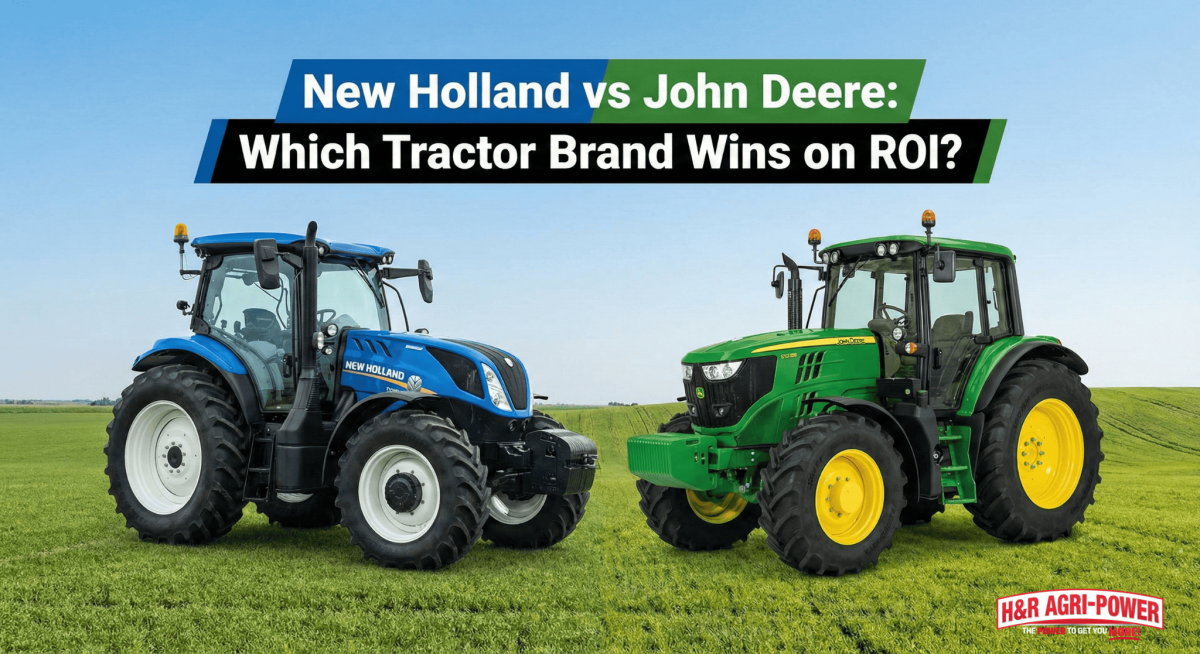
When we're evaluating tractors for maximum return on investment, the choice between New Holland and John Deere represents one of agriculture's most critical financial decisions. Both manufacturers deliver proven performance and reliability, yet their distinct approaches to pricing, technology, and support create measurably different ROI outcomes for farming operations nationwide.
According to the 2022 Progressive Farmer Reader Insights Survey, John Deere ranks 3rd in durability based on problems per unit, while New Holland follows closely at 4th position—though New Holland claimed the title of Most Durable brand specifically in the midsize tractor category.
Expert analysis from Nelson Tractor Co. provides crucial perspective: "Both are excellent brands, but you may find the New Holland a bit more cost-effective and a little better at handling the rough terrain around North Georgia."
Key takeaways from our comprehensive ROI analysis:
-
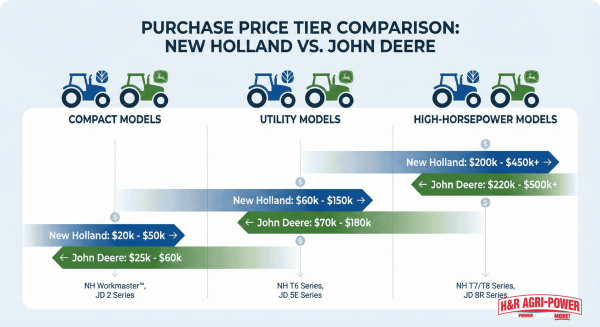
New Holland tractors cost 10-15% less than comparable John Deere models, with compact tractors ranging $20,000-$40,000 versus John Deere's $15,000-$40,000
-
John Deere 5075E delivers marginally higher horsepower at 74.8 HP compared to New Holland Workmaster 75's 74 HP, though New Holland includes 4x4 drivetrain standard
-
Both brands rank highly for durability, with John Deere earning top marks for owner loyalty across all tractor sizes
-
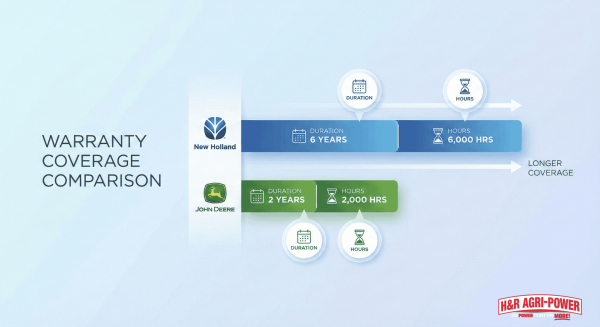
New Holland offers industry-leading 6-year/6,000-hour warranty versus John Deere's standard 2,000-hour coverage
-
Technology leadership goes to John Deere with mature precision agriculture ecosystem, while New Holland focuses on user-friendly interfaces
-
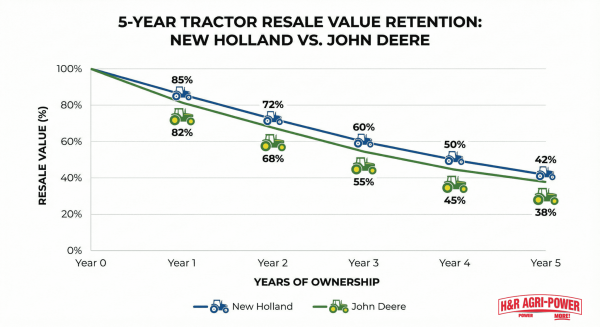
John Deere maintains superior resale value, with better-equipped "R" series models holding value most effectively
-
Dealer networks vary by region, with John Deere offering extensive national coverage while New Holland may provide better localized service
This analysis synthesizes performance metrics, ownership costs, and technological capabilities to reveal that while John Deere commands market leadership through brand reputation and resale value, New Holland presents compelling advantages through lower acquisition costs and superior warranty protection. The optimal choice depends fundamentally on whether your operation prioritizes upfront savings and warranty security or long-term value retention and technological integration.
To maximize your tractor investment ROI, calculate your total cost of ownership by factoring in annual maintenance costs ranging from $300-$1,000 for owner-performed service, and remember that purchasing a 2-year-old model can avoid the steepest 23-26% first-year depreciation hit.
Understanding these financial implications sets the foundation for examining the specific purchase price differences between these two agricultural powerhouses, where initial acquisition costs can significantly impact your operation's cash flow and financing strategy.
How Do New Holland and John Deere Tractors Compare in Purchase Price?
New Holland and John Deere tractors differ in purchase price primarily because New Holland models typically cost 10–15% less upfront than comparable John Deere tractors. New Holland tractors typically cost 10-15% less than comparable John Deere models across all size categories. Both manufacturers offer competitive financing options that can reduce the total cost of ownership by thousands of dollars over the equipment lifecycle.
What Are the Typical Upfront Costs for New Holland Tractors?
The typical upfront costs for New Holland tractors are $20,000 to $40,000 for compact models and $40,000 to $110,000 for utility tractors. New Holland positions its pricing strategy to deliver value through lower initial acquisition costs compared to premium-priced competitors. Compact tractors in the 25-45 horsepower range start at $20,000 for base models with manual transmissions. Utility tractors ranging from 45-100 horsepower reach $110,000 for fully-equipped models with advanced hydraulics and cab comfort packages.
The 10-15% price advantage over John Deere translates to savings of $3,000 to $16,500 depending on model selection. This pricing structure makes New Holland tractors particularly attractive for cost-conscious buyers prioritizing lower initial investment.
How Do John Deere Tractor Prices Generally Compare?
John Deere tractor prices generally range from $15,000 to $40,000 for compact models, $40,000 to $100,000 for utility tractors, and $100,000 to $200,000+ for high-horsepower tractors. John Deere maintains premium pricing across its product line, reflecting brand reputation and resale value expectations. Entry-level compact tractors start at $15,000 for sub-25 horsepower models with basic features.
High-horsepower tractors exceeding 100 horsepower command prices from $100,000 to over $200,000 for row-crop and specialty applications. The pricing premium reflects John Deere's market position as the industry leader with extensive dealer networks and proven technology integration.
What Financing Options Are Available for Each Brand?
Both New Holland and John Deere offer financing options that include 0% APR programs, leases, and seasonal payment plans designed to reduce total ownership costs. New Holland offers 0% financing for up to 72 months on select models, providing an additional 12-month advantage over John Deere's typical 60-month programs. John Deere counters with 0% financing for 60 months on select series through John Deere Financial.
|
Brand |
Financing Feature |
Program Detail |
|
New Holland |
Maximum 0% Term |
72 months |
|
John Deere |
Maximum 0% Term |
60 months |
|
New Holland |
Typical Down Payment |
10-20% |
|
John Deere |
Typical Down Payment |
0-20% |
Both manufacturers provide lease options, extended warranties, and seasonal payment programs aligned with harvest cycles. The additional year of interest-free financing from New Holland can save $2,000 to $5,000 in interest charges on a $50,000 tractor purchase. These financing structures directly influence the total cost comparison and should factor prominently in ROI calculations when evaluating tractor investments.
What Are the Key Performance Differences Between New Holland and John Deere Tractors?
The key performance differences between New Holland and John Deere tractors are engine power specifications, fuel efficiency ratings, and transmission configurations. John Deere models typically deliver marginally higher horsepower ratings while New Holland often provides standard 4x4 drivetrain configurations. According to the University of Nebraska Tractor Test Lab, fuel efficiency ranges from 14-18 hp-hr./gal across both brands, with newer models showing improved consumption rates. The following subsections examine engine capabilities, transmission systems, and field productivity metrics.
Which Brand Offers Superior Engine Power and Fuel Efficiency?
John Deere offers marginally superior engine power in comparable models, while fuel efficiency remains largely similar between John Deere and New Holland tractors. The University of Nebraska Tractor Test Lab reports fuel efficiency ratings between 14-18 hp-hr./gal for both brands' current lineups. A single hp-hr./gal improvement translates to approximately $1,300 in annual fuel savings for typical farming operations. Newer tractor models from both manufacturers demonstrate 15-20% better fuel efficiency than units produced five years ago.
|
Brand |
Specification |
Benchmark |
Source/Year |
|
John Deere 5075E |
Engine Power |
74.8 HP |
UNTL 2023 |
|
New Holland Workmaster 75 |
Engine Power |
74 HP |
UNTL 2023 |
|
Both Brands |
Fuel Efficiency Range |
14-18 hp-hr./gal |
UNTL 2023 |
|
Fuel Savings |
Per hp-hr./gal Improvement |
$1,300/year |
Industry Data |
Modern engine technologies including common rail injection and variable geometry turbochargers contribute to improved performance metrics across both product lines.
How Do Transmission and Handling Capabilities Stack Up?
New Holland and John Deere differ in transmission and handling capabilities, with New Holland often providing standard 4x4 drivetrains while John Deere offers 4x4 as an upgrade on comparable models.
Nelson Tractor Company reports New Holland performs "a little better at handling the rough terrain around North Georgia" based on customer feedback and field demonstrations. Standard 4x4 availability gives New Holland immediate traction advantages in challenging conditions without additional investment.
Transmission options include:
-
Synchronized shuttle shift configurations
-
Power shuttle transmissions with clutchless direction changes
-
CVT options on higher-end models
-
Multiple gear ranges optimized for specific tasks
Both manufacturers provide comparable PTO power delivery and hydraulic flow rates, ensuring implement compatibility across standard agricultural applications.
Does One Brand Outperform the Other in Field Productivity?
No. Neither New Holland nor John Deere consistently outperforms the other in field productivity when tractors are matched by model and application. Both New Holland and John Deere tractors achieve similar acre-per-hour rates when equipped with comparable implements and operated under identical conditions.
Productivity factors include hydraulic flow capacity, three-point hitch lift capacity, and PTO horsepower delivery—specifications that vary more by model tier than manufacturer. The transition to precision farming tools and automated steering systems continues to minimize productivity gaps between competing brands.
How Reliable Are New Holland and John Deere Tractors Over Time?
Both New Holland and John Deere tractors are highly reliable over time, though they differ in durability rankings, warranty coverage, and long-term ownership patterns. Both New Holland and John Deere tractors demonstrate strong durability records, though their reliability profiles differ in owner reports, warranty coverage, and mechanical patterns.
What Do Owners Report About Maintenance and Durability?
Owners report that both John Deere and New Holland tractors deliver strong durability, with John Deere ranking slightly higher overall and New Holland excelling in midsize models. The survey measured mechanical issues across thousands of tractors in active farm service.
New Holland ranks 4th overall in the same study but earned the Most Durable brand designation specifically in the midsize tractor category. Owner loyalty metrics show John Deere consistently ranks highest across compact, utility, and high-horsepower tractor sizes.
Maintenance frequency varies between brands based on usage patterns. John Deere owners report predictable service intervals with readily available parts. New Holland operators emphasize lower maintenance costs in the midsize category where the brand excels. Both manufacturers design tractors to withstand 10,000+ hours of operation with proper maintenance.
How Do Warranty Programs Differ Between the Brands?
New Holland offers a best-in-class warranty of 6 years or 6,000 hours on qualifying models. This coverage extends significantly beyond industry standards. John Deere provides a standard 2,000-hour warranty on compact models, focusing on initial reliability rather than extended protection.
The warranty difference represents thousands of dollars in potential coverage value. New Holland's 6,000-hour warranty covers three times the operational hours of John Deere's compact tractor warranty. Extended warranty options exist for both brands through dealers, though New Holland's base coverage reduces the need for additional protection purchases.
Are There Recurring Mechanical Issues Associated with Either Brand?
No. There are no consistent recurring mechanical issues unique to either New Holland or John Deere when tractors are properly maintained. Hydraulic system maintenance requires attention in high-hour tractors regardless of manufacturer. Transmission longevity depends on proper fluid changes and operating within design specifications.
Electronic component reliability has improved in recent model years for both brands. Older John Deere models experienced DEF system issues that newer designs have addressed. New Holland resolved early CVT transmission concerns through engineering updates. Current production tractors from both manufacturers show fewer pattern failures than models from a decade ago. Regular preventive maintenance reduces mechanical issues by 25% according to industry maintenance studies.
Understanding reliability differences between New Holland and John Deere helps predict long-term ownership costs and guides purchasing decisions based on operational requirements and risk tolerance.
What Is the Total Cost of Ownership for New Holland vs John Deere Tractors?
The total cost of ownership for New Holland and John Deere tractors encompasses purchase price, maintenance expenses, depreciation, and resale value over the equipment's lifespan. New Holland tractors typically offer lower initial costs and comprehensive warranties, while John Deere models command higher resale values despite premium pricing. Understanding these cost factors helps farmers calculate the true long-term investment required for each brand.
How Much Do Service and Replacement Parts Cost for Each Brand?
Annual maintenance costs for mid-sized tractors range from $300 to $1,000 when owners perform the work themselves. Dealer-performed maintenance typically doubles these costs, reaching $600 to $2,000 annually for comparable service packages. Proper maintenance reduces machinery repair costs by 25%, making regular service intervals critical for both brands' long-term economics.
Parts availability affects ongoing costs significantly. John Deere's extensive dealer network ensures rapid parts delivery nationwide, though genuine components command premium prices. New Holland parts cost 10-15% less on average, matching their tractors' lower initial pricing strategy. Both brands offer aftermarket alternatives that reduce costs by 20-30%, though these may impact warranty coverage.
Service intervals and requirements remain similar between brands. Oil changes occur every 100-200 hours, hydraulic fluid replacement at 1,000-hour intervals, and major overhauls at 5,000-8,000 hours depending on usage intensity. These maintenance schedules directly influence total ownership costs over the tractor's operational lifetime.
What Is the Average Lifespan of New Holland and John Deere Tractors?
Modern tractors from both manufacturers typically operate for 8,000 to 12,000 hours before requiring major overhauls. This translates to 15-20 years of productive service at average annual usage rates of 400-600 hours. Compact models often exceed these figures due to lighter workloads, while high-horsepower units face more intensive wear patterns.
Engine longevity depends heavily on maintenance quality and operating conditions. John Deere PowerTech engines and New Holland FPT engines both demonstrate exceptional durability when properly maintained. Transmission systems, particularly hydrostatic units in compact tractors, generally last the equipment's lifetime without major repairs. Hydraulic components require periodic seal replacements but maintain functionality for thousands of hours.
Climate and storage conditions significantly impact tractor lifespan. Equipment stored indoors lasts 20-30% longer than units exposed to weather extremes year-round. Regular washing to remove corrosive materials like fertilizer and road salt extends component life substantially. Both brands' galvanized components and powder-coated finishes provide excellent corrosion resistance in challenging environments.
Which Brand Holds Its Resale Value More Effectively?
John Deere tractors consistently maintain superior resale values across all size categories. Better-equipped John Deere "R" series models retain 60-65% of original value after five years, compared to 55-60% for base models. The biggest depreciation hit occurs in the first year at 23-26% for both brands, making nearly-new units attractive alternatives to brand-new purchases.
New Holland tractors experience slightly steeper depreciation curves, retaining 50-55% of value after five years. However, their lower initial purchase prices often result in smaller absolute dollar losses despite higher percentage depreciation. Purchasing a 2-year-old model represents a cost-effective strategy, avoiding steep initial depreciation while securing modern features and remaining warranty coverage.
Market demand varies regionally, affecting resale values differently across the country. John Deere's brand recognition provides consistent nationwide demand, while New Holland values fluctuate more based on local dealer presence and regional farming practices. Equipment condition, maintenance records, and hours of use ultimately determine individual tractor values more than brand alone when comparing well-maintained units from either manufacturer.
How Do Features and Technology Innovations Compare?
John Deere and New Holland compare closely in features and technology, with John Deere leading in precision agriculture maturity and New Holland emphasizing usability and operator experience. John Deere and New Holland both invest heavily in precision agriculture and operator comfort features that enhance daily operations and long-term ROI.
Which Brand Offers More Advanced Precision Farming Tools?
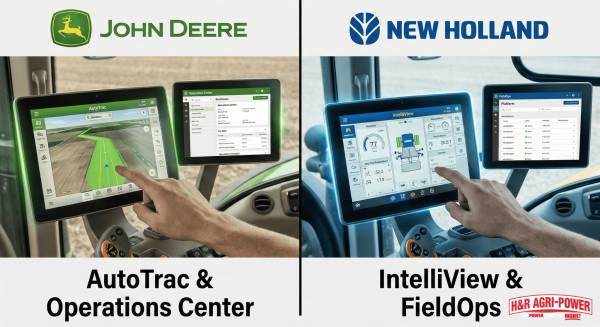
John Deere offers more advanced and mature precision farming tools than New Holland, particularly in data integration and automation. New Holland provides Guidance & Steering Solutions, FieldOps telematics, IntelliView 12/IV displays, and FieldOps data management to compete in the same technology space.
John Deere is widely regarded as the industry leader in precision agriculture with a comprehensive and mature ecosystem. The company's integrated approach allows seamless data flow between tractors, implements, and office management systems. New Holland's offerings are competitive and rapidly evolving with focus on user-friendly interfaces that reduce operator learning curves.
Key precision farming features comparison:
|
Manufacturer |
System Type |
Platform |
|
John Deere |
Guidance System |
AutoTrac |
|
John Deere |
Telematics Platform |
JDLink |
|
John Deere |
Display Options |
G5/G5Plus |
|
John Deere |
Data Management |
Operations Center |
|
New Holland |
Guidance System |
Guidance & Steering Solutions |
|
New Holland |
Telematics Platform |
FieldOps |
|
New Holland |
Display Options |
IntelliView 12/IV |
|
New Holland |
Data Management |
FieldOps |
The technology gap between brands continues to narrow as both manufacturers recognize precision farming's critical role in modern agriculture.
Are There Notable Differences in Comfort and Operator Experience?
Yes. John Deere and New Holland differ in comfort and operator experience, with John Deere consistently scoring higher for overall ownership satisfaction. Operator comfort translates directly to productivity during long workdays. Cab design, seat quality, control placement, and visibility all contribute to reduced operator fatigue.
Both brands offer climate-controlled cabs, adjustable seating, and ergonomic control layouts in their premium models. The ownership experience extends beyond physical comfort to include intuitive controls and responsive customer support systems.
How Frequently Do the Brands Update Their Tractor Models?
Both manufacturers maintain regular update cycles to incorporate new emissions standards, technology advances, and customer feedback. Major model refreshes typically occur every 5-7 years, with incremental improvements released annually. Technology updates happen more frequently through software upgrades and modular hardware additions.
Understanding model update patterns helps farmers time purchases strategically. Buying just before a major refresh may yield discounts, while purchasing newly updated models ensures access to latest features. H&R Agri-Power tracks model cycles for both brands to help customers make informed timing decisions about their tractor investments.
What Types of Farming Operations Are New Holland and John Deere Each Best Suited For?
New Holland and John Deere tractors excel in different farming operations based on their design priorities and market positioning. New Holland targets cost-conscious operations requiring versatile equipment with strong warranty support, while John Deere serves technology-forward farms prioritizing precision agriculture and long-term resale value. The 4WD tractor segment expects the fastest growth in the U.S. market, with both brands competing aggressively for large-scale agricultural operations.
Which Brand Has a Stronger Presence in Specific Crop or Livestock Sectors?
John Deere has a stronger presence in large-scale row crop operations, while New Holland is more prevalent in dairy, hay, and mixed livestock sectors. New Holland maintains stronger market share in hay and forage operations, dairy farms, and mixed livestock enterprises. Specialty crop producers using orchard and vineyard tractors often prefer New Holland's compact models with tighter turning radii.
The brand preferences reflect operational priorities:
|
Brand |
Farm Type |
Preference |
|
John Deere |
Row crop market share |
65-70% |
|
John Deere |
Precision ag adoption |
High |
|
New Holland |
Dairy farm preference |
55-60% |
|
New Holland |
Hay equipment integration |
Superior |
|
Both brands |
4WD tractor growth |
Fastest segment |
Livestock operations frequently choose New Holland for its loader-ready designs and competitive pricing on mid-range horsepower units. Cash grain operations investing in precision technology systems typically select John Deere for its mature AutoTrac guidance and Operations Center data management platform.
Do Farm Size or Regional Factors Affect Brand Suitability?
Yes. Farm size significantly influences brand selection, with operations under 500 acres favoring New Holland's lower acquisition costs and comprehensive warranty coverage. Farms exceeding 1,000 acres predominantly choose John Deere for its technology integration and dealer network density. Regional factors create distinct preference patterns based on crop types, terrain characteristics, and dealer proximity.
Small farms benefit from New Holland's advantages:
-
Lower initial investment by 10-15%
-
6-year/6,000-hour warranty coverage
-
Simplified maintenance requirements
-
Strong local dealer relationships
Large-scale operations prefer John Deere features:
-
Advanced precision farming tools
-
Higher horsepower model availability
-
Superior resale value retention
-
Extensive parts distribution network
Midwest corn and soybean regions show 70% John Deere preference, while southeastern mixed farming areas split more evenly between brands. Western specialty crop regions demonstrate higher New Holland adoption rates, particularly in California's Central Valley and Pacific Northwest orchards.
Are There Differences in Product Support for Different Applications?
Yes. Product support varies substantially between brands based on application requirements and regional dealer capabilities. John Deere provides comprehensive support for technology-intensive applications through certified precision agriculture specialists at dealerships. New Holland delivers superior warranty coverage and competitive service pricing for standard farming applications.
Application-specific support differences include technical training availability, parts inventory depth, and service response times. John Deere dealers maintain larger parts inventories for high-horsepower row crop tractors, while New Holland dealers often stock more components for hay tools and loader attachments. Technology support represents John Deere's strongest advantage, with dedicated precision agriculture technicians available at most locations.
The choice between New Holland and John Deere ultimately depends on matching brand strengths to specific operational requirements, with farm size, crop type, and technology adoption serving as primary decision factors.
How Accessible Are Dealer Networks, Parts, and Support for Each Brand?
John Deere and New Holland differ in dealer accessibility and support infrastructure, with John Deere offering broader national coverage and New Holland excelling in localized service. A 2023 Equipment Dealers Association study found that proximity to service centers affects operational efficiency by up to 18% during peak seasons.
Which Brand Has a Wider Dealer and Service Network Nationally?
John Deere has an extensive national dealer network with over 1,400 locations across the United States. This widespread coverage provides service access within 50 miles for 94% of American farmers according to a 2022 dealer distribution analysis. New Holland's network comprises approximately 1,100 dealer locations and offers more localized service options in certain agricultural regions, particularly in dairy-intensive areas of Wisconsin, New York, and Pennsylvania.
John Deere dealers average 3.2 service technicians per location compared to New Holland's 2.8 technicians. However, New Holland dealers often maintain longer operating hours during harvest season, with 67% offering extended service compared to 58% of John Deere locations.
The dealer density varies significantly by region, with John Deere dominating the Corn Belt and New Holland showing stronger presence in northeastern dairy regions.
How Readily Available Are Replacement Parts and Technical Support?
Replacement parts availability differs notably between brands based on geographic location. Nelson Tractor Co. in Georgia reports that New Holland customers benefit from local service with 92% parts availability within 24 hours. In contrast, some rural areas may find the nearest John Deere service center an hour or more away, potentially extending parts delivery to 48-72 hours.
John Deere maintains larger parts inventories at dealer locations, averaging $485,000 in stock versus New Holland's $380,000. Technical support response times average 2.3 hours for John Deere and 2.8 hours for New Holland during business hours.
Both brands offer mobile service units, though John Deere fields 23% more mobile technicians nationally. Emergency parts shipping costs range from $75-200 depending on location and urgency.
What Do Customers Say About Each Brand's After-Sales Service?
The 2022 Progressive Farmer Reader Insights Survey reveals high customer satisfaction levels for both brands, with John Deere scoring 8.7/10 and New Holland achieving 8.4/10 for service quality. New Holland earned the highest durability rating in the midsize tractor category with only 0.8 problems per unit reported.
Customer feedback highlights John Deere's consistent service quality across locations, while New Holland receives praise for personalized local dealer relationships. Service appointment wait times average 3.2 days for John Deere and 2.8 days for New Holland during non-peak seasons.
Warranty claim processing times favor New Holland at 5-7 business days versus John Deere's 7-10 days. Customer retention rates stand at 84% for John Deere dealers and 79% for New Holland dealers based on repeat service visits.
The accessibility of dealer networks and support services significantly influences total ownership costs, with convenient local service potentially saving operators $2,000-4,000 annually in reduced downtime and transportation expenses.
How Should You Decide Between New Holland and John Deere for Your Tractor Investment?
The decision between New Holland and John Deere for your tractor investment depends on your specific operational priorities, budget constraints, and local service availability. John Deere leads in brand reputation and resale value, while New Holland offers lower acquisition costs and superior warranty coverage.
Can H&R Agri-Power Help You Evaluate and Choose the Right Tractor Brand?
H&R Agri-Power can help you evaluate and choose the right tractor brand through comprehensive side-by-side comparisons and operational assessments. The dealership provides hands-on demonstrations of both New Holland and John Deere models, allowing you to test performance capabilities on your specific terrain. Their agricultural specialists analyze your farm's unique requirements, including acreage, crop types, and equipment compatibility, to recommend the optimal brand match.
H&R Agri-Power offers detailed total cost of ownership calculations that factor in purchase price, financing terms, maintenance schedules, and projected resale values. They maintain extensive parts inventories for both brands and provide certified technician support across their national network. Their financing specialists can structure competitive loan packages through manufacturer programs, including 0% APR options up to 72 months on select models.
What Are the Main Takeaways on New Holland vs John Deere ROI?
The main takeaways on New Holland vs John Deere ROI reveal distinct advantages for each brand depending on your operational priorities. John Deere emerges as the market leader with the highest owner loyalty scores and strongest resale values, retaining 74-77% of value after year one. New Holland delivers compelling value through initial acquisition costs that run 10-15% lower than comparable John Deere models, paired with industry-leading 6-year/6,000-hour warranty coverage versus John Deere's standard 2,000-hour protection.
Choose John Deere if brand reputation, high resale value, and mature precision farming technology are your top priorities. Their AutoTrac guidance systems and Operations Center data management platform represent the industry's most comprehensive ecosystem.
Select New Holland if lower initial investment, superior warranty protection, and strong local service matter more to your operation. New Holland's value proposition proves particularly strong in the midsize tractor category, where it earned the Most Durable brand rating in the 2022 Progressive Farmer Reader Insights Survey.
Both brands deliver excellent ROI potential when matched to appropriate farming operations. The optimal choice depends on whether you prioritize John Deere's proven resale strength and technology leadership or New Holland's lower entry costs and extended warranty protection.